
pattern recognition receptor (PRR) is mainly expressed on the surface of innate rabbit disease cells, non-clonally distributed biological macromolecules, and it can recognize one or more pathogen-associated molecular patterns (PAMP) or damage-associated molecular patterns (DAMP). Pattern recognition receptors (PRRs) are representatives of immune receptors in innate immunity, encoded by a limited number of germline genes, and are evolutionarily conserved, indicating that PRRs are extremely important for the survival of organisms. The mutual recognition and interaction of PRR and PAMP is the key to initiate the innate immune response. Compared with lymphocyte receptors in adaptive immunity, PRR is not only encoded by germline genes, but also has three characteristics, including constitutive expression, rapid response and ability to recognize various pathogens.
Tipuri principale de PRR în mamifere
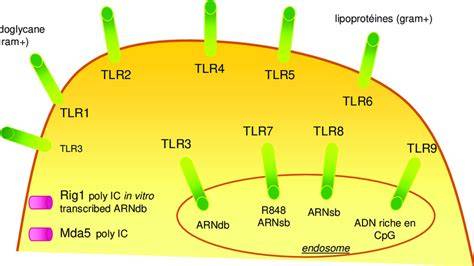
Generally, there are four types of PRRs in mammals, involving Toll-like receptors (TLRs), RIG-I-like receptors ( RLRs) , Nod-like receptors (NLRs), C-type lectin receptors (CLRs) and a series of intracellular DNA sensors.
TLR: receptorii recunoașterii liganziu în afara celulei
1. Toll-like receptors (TLRs), named for their structural similarity to the Toll protein in Drosophila, are the first PPRs identified and widely studied in a variety of animals from insects to humans. The members of this family are all glycoproteins, the N-terminus is a leucine-rich repeat motif (LRR) with substrate binding ability toward the extracellular; the other side is homologous to the IL-1 receptor, known as the Toll/interukin-1 receptor (TIR) domain, which is a signaling domain necessary for initiating downstream signaling pathways, primarily responsible for transduction of signals into cells. 10 Toll-like receptors (TLR1-TLR10) have been identified in the human genome and 12 Toll-like receptors (TLR1-TLR9, TLR11-TLR13) have been identified in the mouse genome. Activation of the TLRs signaling pathway originates from a domain of the cytoplasmic Toll/IL-1 receptor (TIR) that interacts with the adaptor protein MyD88 contained in the TIR domain. Upon ligand stimulation, MyD88 attracts IL-1 receptor-associated kinase-4 (IRAK-4) to TLRs through the interaction of two molecular death domains.
NLRs și CLRs: receptori intracitoplasmatici și recunoaștere a carbohidraților
2. Nod-like receptors (NLRs) belong to the cytoplasmic PRRs, and there are several different subtypes. Structurally, NLRs share three domains, including leucine rich repeat (LRR) domain, NOD and Caspase recruitment domain (CARD). LRR domain is at the C-terminus of NLRs and can recognize the corresponding ligand; NOD is the middle domain and belongs to the NTPase superfamily member, which can hydrolyze ATP to GTP. CARD is at the N-terminus and greatly varies in different members of NLRs family. As one of the members of intracellular PRRs, NLR, together with TLR, is a kind of sensor of innate immunity against pathogens. At present, studies have found that NLRs family includes 23 members in human. The expression of NLRs is different from TLRs. TLRs are mainly expressed on the surface of cells or endophages, while NLRs are expressed in the cytoplasm of various cells such as immune cells and epithelial cells. Some members of NLRs family are mainly expressed in phagocytes and neutrophils. in the cytoplasm of granulocytes.
3. C-type lectin receptors (CLRs) are a huge protein superfamily. A typical CLR contains one or more glycosyl recognition domains (CRDs), and there are two Ca2+ binding sites necessary for CLR function on the protruding loop on the protein surface. CLRs are divided into two types, including secretory type and transmembrane type. The main representative of secretory type CLR is the agglutinin family. Transmembrane type CLR is divided into type I and type II according to the orientation of its N-terminus. Most CLRs expressed by DCs belong to type II transmembrane proteins, with the exception of manna receptor (MR) and DEC-205, which are type I. All type II CLRs contain one CRD. Whereas, MR and DEC205 contain 8 and 10 CRDs, respectively. As many as 60 CLRs have been identified in humans. Some of these soluble CLRs are capable of binding PAMPs and may mediate host defense under certain conditions. For example, mannose-binding lectins can bind to various modified viral, bacterial, fungal and parasitic glycosyl groups and can block the invasion of Neisseria meningitidis, Staphylococcus aureus and Streptococcus pneumoniae.
Relevanța practică a receptorilor PRR
CUSABIO a listat some popular targets related pattern recognition receptor. Neuronii sunt capabili sa sintetizeze o serie de neurotransmitatori inca din perioada embrionara a dezvoltarii organismului uman si continua pe toata durata vietii individului. Dupa eliberare de la locul sintezei, majoritatea neurotransmitatorilor se leaga de receptori specifici postsinaptici, influentand in mod direct potentialul de membrana, insa exista si mecanisme mai complexe de actiune ale acestor substante chimice, care se refera la canalele ionice responsabile de aparitia unui raspuns tardiv al celulei tinta.
Conectarea dintre PRR și neurotransmiteri
Functionarea neurotransmitatorilor si PRR poate implica interacțiuni complexe între semnalizarea imună înnăscută și comunicarea neuronala, indicând potențiale canale de crosstalk între imunitate și neurochimie.
Note despre componentele receptorilor și semnalizarea
- Receptorii celulari detectează liganzi specifici; legarea lor inițiază transducția semnalului și răspunsuri intracelulare.
- Major types of receptors include cell-surface receptors (GPCRs, ion channel, enzyme-linked) and intracellular receptors, fiecare având roluri distincte în fiziologie și patologie.
- Receptorii pot acționa ca „urechile” și „ochii” celulei, permițând percepția mesajelor din mediul înconjurător, inclusiv hormoni și neurotransmițători.
Implicarea în sănătate și medicină
Understanding receptor mechanisms is vital for developing targeted therapies for various diseases. Receptors are proteins that bind specific signaling molecules, initiating cellular responses. They function by transducing external signals into internal cellular changes, with major types including GPCRs, ligand-gated ion channels, RTKs, and intracellular receptors. The diversity of receptor types reflects the complexity of cellular signaling required for physiological regulation and immune defense.
În contextul imunității, receptorii precum TLR, NLR, CLR, și alți senzorii intracitoplasmatici coordonează răspunsuri la PAMPs și DAMPs, declanșând procese de inflamație, recrutare a celulelor și activare genetică a răspunsurilor imune. În învățarea despre neurobiologie, receptorii axați pe sistemul nervos pot modula comunicarea sinaptică prin canale ionice și mecanisme G-protein-coupled, influențând simptomele și tulburările neurologice asociate cu dezechilibrele neurotransmițătorilor.
Ce este imunitatea? Ce sunt anticorpii? O explicație simplă pentru toți
Concluzii despre mecanismele PRR
Receptori de recunoaștere a pattern-urilor sunt conservatori evolutiv și ocupa o funcție centrală în supraviețuirea organismelor, acționând ca primul scut împotriva patogenilor prin recunoașterea PAMPs/DAMPs și inițierea răspunsului imunitar înnăscut.
| Tip PRR | Localizare | Rol principal | Exemple |
|---|---|---|---|
| TLR | suprafața celulară, endosome | transducerea semnalelor și activarea inflamației | TLR1-TLR10 |
| NLR | citoplasmatic | senzori intracitoplasmatici, inflammasomii | diverse subtipuri |
| CLR | membranari, DC | recunoaștere glicano-patogeni | MR, DEC-205 |
| RLR | citosol | recunoaștere RNA virală | RIG-I, MDA5 |
tags: #receptori #pt #recunasterea #paternului
Postări populare:
- Colac pentru copii 14 kg: ghid practic pentru siguranță la baie la 1 an și 5 luni
- Ghid practic pentru tratamente sigure pirozis în timpul sarcinii
- Razvan Mihaileanu, medic ginecolog, Tarnaveni — opinii și detalii
- Beneficii ale șamponului Bebe Confort și cum se utilizează
- Copilul minte: explicatii de la un psiholog pediatru din Timisoara